Showing posts with label French-Indian War. Show all posts

Tuesday, August 9, 2011

Ten Minutes That Changed America

In the book, The Plains of Abraham, the battle on The Plains of Abraham was characterized as "brief though the savage clash of arms had been, their two little armies had fought one of the battles which have changed the face of history. They were the ten minutes that changed America." The British Army led by General Wolfe defeated the French Army led by General Montcalm.

"For a century the French had laboured to draw a vast cordon round the British possessions in North America. Up the Mississippi it ran from New Orleans and through the Great Lakes to the St. Lawrence estuary."

The British colonies were east of the Appalachian Mountains for the most part, although King George II issued land grants ca 1748 for land in the Ohio River Valley.

"With the wild Indian allies they so sedulously cultivated, the French King's henchmen sought to pin the British colonists to the line of the Appalachian range and
deny them the interior of the continent.  Wolfe's victory broke their [the French] hold for ever.  Into the vacuum surged the progenitors of the American Revolution."

The most famous of those who "surged" after their French-Indian War experience was George Washington.

Tuesday, July 26, 2011

Detroit In The French-Indian War Prelude

 In honor of Detroit's 307th birthday, July 24, 2011, a glimpse of Detroit in its youth.  At one time Detroit was a strategic location over which the British and the French were vying for control.

From The Plains of Abraham by Brian Connell:

While the British delegates became increasingly distrustful of what they called the trickery, time-wasting and tergiversation of the French, their opponents were putting the delay to good effect. Probing, pinpricking and plotting with the Indians, the French were determined to nullify Britain's gains in the war.

A French officer, Celoron de Bienville (Commandant at Detroit in 1743), with a small armed party was sent to make an ostentatious display of force on the long river circuit down the Allegany and Ohio and then up the Miami and Maumee back to Detroit.

 Father Bonnecamp's Map From de Bienville's Expedition

Sunday, July 3, 2011

Saved By An Act of Disobedience

From The Plains of Abraham by Brian Connell:


"By an inspired piece of undiscipline, Barre ignored the order, and some historians, drawing the parallel with the party of light infantry who found the landing-place at Louisbourg, have suggested that this was the second time that Wolfe was saved by an act of disobedience. As soon as the boats were emptied, Barre sent them back again to bring off Townshend's brigade from the ships now arriving. They then went to fetch Burton's reserve from Point Levis....".

Wednesday, June 15, 2011

Objectives of the French-Indian War

From The Plains of Abraham by Brian Connell, in reference to the French-Indian War:

Like most wars, it achieved few of its initial objectives. The French, who had thought to humble Britain as a colonial power, lost almost their entire overseas empire. The British, not without intent, found themselves masters of vast new territories and most of the world's trade, but so mismanaged the fruits of victory in North America that they evoked among the colonists the unity--and the issues--which formed the basis of their struggle for independence.

The first sentence is something to keep in mind when evaluating present day events.

Tuesday, May 24, 2011

Incompetence In the French-Indian War

A comment from The Plains of Abraham by Brian Connell (written about the French-Indian War):

What facilitated the enterprises of the French, wrote Horace Walpole...was the extreme ignorance in which the English Court had kept themselves of the affairs of America.

That department is subjected to the Secretary of State for the Southern Province, assisted by the Board of Trade. That Board, during Sir Robert Walpole's administration, had very faultily been suffered to lapse almost into a sinecure, and during all that period [for nearly thirty years until 1754] the Duke of Newcastle had been Secretary of State. ...reams of papers...lay mouldering and unopened in his office.... .


Only one of many ways to defeat oneself.

Saturday, September 25, 2010

No British Oppression Of The American Colonies In The 1750's - What Changed?

The point about no British oppression prior to the French-Indian War era was presented in The Plains of Abraham by Brian Connell:

..There were, in the whole of British North America, precisely five independent companies of regular troops, two in New York, another in Jersey and two more in the Carolinas, manning frontier forts against Indian raids--a grand total of perhaps five hundred men. At least no one can claim that the British colonies were held in subjection by force of arms.

Life in the British colonies was barely ruffled by the impending storm. Even the most perfervid anti-imperialist has a difficult time finding evidence of 'oppression' in the British colonies in North America in the 1750's.

The turning point came at the end of the war George Washington had started. The condition that made it possible at all was the removal of the French.
The colonists had enjoyed almost unfettered political development, within the franchise restrictions they themselves chose to impose.

According to this source, "it had been determined to place a permanent force of about 10,000 men (British troops) in America;" quite an increase from the 500 or so quoted above. So The Stamp Act was enacted to raise funds in the American colonies to pay for troops that the colonies did not want.


Though The Stamp Act was repealed, the British Parliament staked out their right to rule the colonies with the Declaratory Act.

The "American Revolution Blog" contrasts the original Tea Party with the 2009 Tea Party, and mentions the Declaratory Act in the discussion.

Friday, September 3, 2010

The Jacobite Who Aided The French

The Plains of Abraham, by Brian Connell, mentioned that an aide-de-camp to General Montcalm was the Chevalier Johnstone, a Scottish Jacobite.

As The Plains of Abraham battle was eminent -- "when the first breathless messages from Vergor's post finally arrived with reports that the whole British army was established on the heights west of the town they were frankly disbelieved. ..... He had already sent an aide-de-camp to Vaudreuil's headquarters near the St. Charles bridge to ask what the Samos firing had been about. No answer had been received and Montcalm set off himself with his Scottish Jacobite aide-de-camp, the Chevalier Johnstone--he had fought with Prince Charles Edward at Culloden--to find out for himself." [POA]

The Chevalier Johnstone himself was an author of three volumes:

Volume III (The Campaign of 1760 In Canada) features an imaginary conversation between the two slain Generals (Montcalm and Wolfe) after the Battle of The Plains of Abraham:

Volume II:
Volume I is entitled "Memoirs of the rebellion in 1745 and 1746":


Another blog, "Flintlock and tomahawk," posted an excerpt of the Chevalier Johnstone's memoirs here.

For the story of the Jacobite who helped General Wolfe and the British in the same battle, see this blogpost. A short film featuring the painting of the Death of General Wolfe can be found here (also from the blog "Flintlock and tomahawk").

Saturday, August 28, 2010

A Jacobite Rebel In Wolfe's Army

A rebel Jacobite, Captain Donald McDonald, was instrumental in Britain's victory at the Plains of Abraham as was mention is the book, The Plains of Abraham, by Brian Connell.

There was a certain irony that Captain McDonald's perfect French, learned as a result of his Jacobite activities as a rebel against the British Crown, was crucial as the British army under General Wolfe gained a foothold in order to do battle with the French who were entrenched in the City of Quebec.

The French had posted sentries at strategic intervals along the beach below the cliffs west of the town. The first post was passed without incident, but at the second a guard sighted the leading boats and immediately challenged them.

Invisible in the dark hour before the dawn, his sharp Qui vive? came as an unwelcome shock. A quick-witted officer of the Fraser Highlanders, Captain Donald McDonald, who in his time had served the Jacobite cause in France and spoke the language perfectly, answered in a low voice, "La France!" The sentry was insistent: "A quel regiment," he demanded--"De la Reine," McDonald ventured, knowing that part of this battalion was with Bougainville. The sentry, apparently satisfied, did not ask for the password.

A little further on, under the Samos battery, another sentry repeated the challenge and he could just be seen running down to the water within pistol shot. What are you speaking so quietly for, he wanted to know. Provision boats, replied McDonald. Don't make noise or the English will hear us. Again the sentry let them pass. (Source: The Plains of Abraham)

From Loyal Lochaber and its associations, it was noted that Captain MacDonald was slain in Quebec:


The use of Jacobite prisoners in North America was suggested to the British government (see below):


Friday, August 20, 2010

General Phineas Lyman In The French-Indian War

The General Orders of 1757, issued by General Phineas Lyman, two years after Lyman was noted as a hero at the Battle of Lake George (New York), on September 8, 1755, logs the daily events undertaken by soldiers and their commanding officer.

First - The Battle of Lake George:


General Orders of 1757: issued by the Earl of Loudoun and Phineas Lyman In The Campaign Against The French, 1899, (250 copies printed):

From Luke Gridley's diary of 1757:


From The Plains of Abraham by Brian Connell:

He (William Johnson) was met by a tremendous fusillade [in the Battle of Lake George], which decimated the [French] men of the regiments of Languedoc and La Reine. Although his Canadians and Indians fanned out to right and left, they had little stomach for the fight. Johnson was early wounded in the leg and carried back to his tent, but his deputy, Phineas Lyman of Connecticut, darting everywhere unscathed in the heat of battle, animated and encouraged the motley force.

Also in the Battle of Lake George, Baron Dieskau was "shot in the leg, deserted by his men and captured."

In the prelude to the Battle of Lake George, "...(Dieskau) learnt by capturing tow of Johnson's messengers that the colonists had a large force on his flank. Changing the direction of his march, he made across country for the head of Lake George. Indian scouts brought the first news of Dieskau's approach to Johnson. He sent a thousand men out to meet them, but this vanguard was ambushed and the whole fled in panic back to Johnson's lines. In the skirmish Legardeur de St. Pierre, Washington's wary rival two years earlier at Fort Le Boeuf, was killed at the head of his Indians."


For his service in the French-Indian War, Phineas Lyman was awarded land interests in the Natchez, Mississippi, area.

Included in the Journal of Gen. Rufus Putnam is a short bio of Phineas Lyman:

Monday, August 9, 2010

Washington & The French-Indian War

The book, The Plains of Abraham, by Brian Connell, published in 1959, is an interesting and comprehensive book about the French-Indian War. One chapter details George Washington's critical role in the events that led to the formal declaration of war.
George Washington had fired the shots which started the conflict still known in America as the French and Indian War. Two years of fighting in the backwoods of North America were to intervene before France and England declared hostilities officially. (Source: Plains of Abraham)
However, before the fateful shots were fired, the French had been ratcheting up the tensions in North America:
Yet another and still more aggressive Governor-General had succeeded in Canada. This was the Marquis de Duquesne, who, in the spring of 1753, sent one of his toughest wilderness officers, Marin, at the head of fifteen hundred Canadians and Indians on an expedition from Fort Presqu'ile, the French strongpoint half-way along Lake Erie. ...they built Fort Le Boeuf...he (Marin) was succeeded by Legardeur de St. Pierre, who retired as autumn closed in, with most of the remaining force, to Fort Le Boeuf (present-day Pennsylvania). (Source: Plains of Abraham)

In the spring of 1754, George Washington was sent to force the French from British territory. Washington had orders from Governor Dinwiddie, who had orders from King George II to stop the encroachment:


If you shall find that any number of persons shall presume to erect any fort or forts within the limit of our province of Virginia, you are first to require of them peaceably to depart; and if notwithstanding your admonitions they do still endeavor to carry out any such unlawful and unjustifiable designs, we do hereby strictly charge and command you to drive them off by force of arms. [Orders of King George II written 28 August 1753 (source)]

On May 28, 1754, at what is now known as the Battle of Jumonville Glen, Washington turned the tables on the French and their planned ambush:
[Source: Our Country by Lossing, 1875]

Washington took the initiative and bested Joseph Coulon de Jumonville, who died in the conflict.
After the battle:
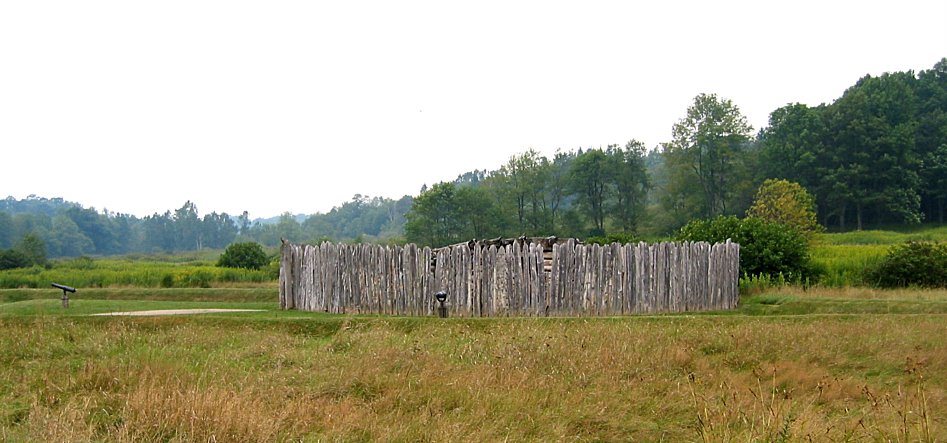
[Washington] retreated back to Fort Necessity. Offering up his own horse as a pack animal, and ordering his fellow officers to do the same, yoking the Virginians, already on half rations because of the failure of the commissariat, to his nine swivel guns, the little force crawled back through the mud. The men of Mackay's (Captain James Mackay) independent company did not raise a finger to help. Washington's exhausted men had three days in which to ready their stockade for defence. His as yet unpractised military mind had chosen ill. Fort Necessity lay in the soggy bottom of a clearing, commanded by three hillocks within musket shot. He had four hundred men, and the French, when they marched out of the forest, had eight hundred. (Source: Plains of Abraham)

Jumonville's older brother led the French and soon retaliated and forced Washington to surrender at Fort Necessity on July 4, 1754.

He (Washington) had to leave behind two hostages against the return of the prisoners taken in his first skirmish in May, one of whom was a Captain Robert Stobo. The arrangement was later repudiated by Dinwiddie, who claimed the prisoners belonged to the colony and not to Washington, and Stobo had to remain in French captivity for five years. Mark his name well. He was to play a vital part under Wolfe at Quebec. (Source: Plains of Abraham)

The articles of capitulation of Fort Necessity can be found here.


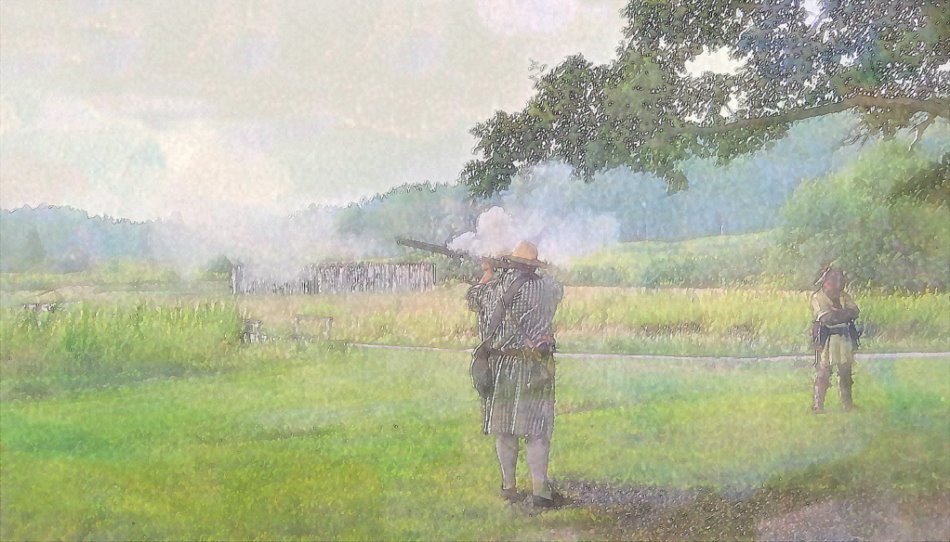
The pictures were taken at Fort Necessity and were originally published here.

A chronological chart of events can be found here.

Wednesday, July 28, 2010

More Characters From The Devil's Backbone

From The Devil's Backbone, The Story of the Natchez Trace, by Jonathan Daniels:

Jedidiah Morse, who wrote the first geography to be published in the United States, spoke of the opulent families both in Natchez and the Cumberland settlements to which the Natchez Trace ran.

First among them was Gen. Phineas Lyman. His interest had been aroused as an officer...to whom the British crown owed gratitude and its newly acquired lands (ca 1763) offered reward. General Lyman was regarded by the British as the ablest and most trustworthy Colonial general in the northern colonies in the French and Indian War. And his prestige, if not his appearance, was enhanced by the fact that he was married to Eleanor, daughter of Col. Timothy Dwight of Northampton, Massachusetts, whose son and great-grandson were both to become presidents of Yale University.

He (Phineas Lyman) must have talked much in the tavern of his old wartime comrade, Israel Putnam, later to become a popular hero of the patriots in the American Revolution. At any rate, Israel and his brother Rufus were stirred by the 'false hopes' Phineas raised about the land. The Putnams left a journal about their explorations (1772-73) but preferred to remain in New England.

Also Devil's Backbone-related posts here and here