Showing posts with label Blogs. Show all posts

Tuesday, June 22, 2021

Dealing With General Sturgis


"Cahaba. A story of captive boys in blue:"

"...a gentleman from Northern Mississippi who informed me that upon his parents' plantation General Sturgis passed the night previous to the battle, making his headquarters in his father's house. He
assured me that Sturgis during his stay imbibed very freely of alcoholics and was stupidly drunk therefrom. This, in a measure, would account for his senseless order upon receiving the despatch from General Grierson. Upon receiving the report of Grierson's staff-officer, without heeding the suggestions it contained, Sturgis renewed his orders to Grierson to push forward, but soon afterward was aroused by a messenger from General Grierson, who brought substantially the following :

" I have not the force at my command to advance farther. It is evident that I have met the bulk of Forrest's forces, but I hold a good position, which I think I can hold until you come up with the infantry."

The message did not imply that Sturgis should use more than ordinary expedition, but upon receiving it the drunken, frenzied commander ordered his infantry to go upon the " double-quick " to the front, a distance of not less than five miles! It should be remembered that the weather was intensely hot, sultry, oppressive; that the road led through a heavy growth of timber; that the men were marching with heavy loads musket, cartridge-box, forty rounds of ammunition, canteen, haversack, and knapsack but they were men who had been seasoned by many a hard campaign, and had never received an order but to obey it. (Source)


Thursday, September 3, 2020

Campaign Of Extermination


"In 1792 Chief John Watts (also known as “Young Tassel”) undertook a campaign of extermination against the Cumberland settlements."

"His plan was to cut off all lines of communication by posting bands of warriors on the two paths leading to the Cumberland, while he, with the main body of 281 warriors, undertook to destroy the fort at Nashville, along with all outlying stations, dwellings, and other improvements."

Fort Southwest Point (near present-day Kingston, Tennessee)

"On hearing of Watt’s plans, Governor Blount ordered Capt. Samuel Handley to take a company of 42 men from Southwest Point to Nashville, and reinforce the garrison there."

We followed the *Avery Trace....(Source)
*"it led from Fort Southwest Point at Kingston through the Cumberland Mountains...from there it worked through the hills and valleys...and finally to Fort Nashborough." (Wikipedia)

"They left Southwest Point over the Cherokee Path, and, upon entering Crab Orchard Gap, were ambushed... ." (From The Upper Cumberland Of Pioneer Times)


Friday, November 1, 2019

Works In The Northern Army For 1776


Source

Memorandum from Jeduthan Baldwin, Engineer of the Northern Army, whose diary description is online:

"Apparently one of Baldwin's last major constructions was an attempt to build a bridge across the narrow water passage between Ticonderoga and what he first called Independency (later Independence) Point. He seems to have designed it and supervised it for some time. Construction began on March 1, 1777. By the time he left Ticonderoga in early July, construction was still under way, and the Americans were in retreat again, so the bridge probably was never finished...  ."

Source

My ancestor, John Backus was At Mount Independence:


John Backus's Revolutionary War Pension:

...Ticonderoga has been then but a short time when he was placed in a redout a short distance from the main fort as an artillerist together with others of the same regiment.

During the winter there was much work done in making something like a bridge across a marsh or a part of the lake from the fort to the foot of mount independence... . 


Monday, June 12, 2017

Near Nashville


FLOWERING of the CUMBERLAND by Harriette Simpson Arnow:


"....[Mr. Buchanan]...had been born in Harrisburg, Pennsylvania, but his father, John, Sr., like so many Pennsylvania borderers, had migrated to North Carolina, settling in the neighborhood of Guilford Courthouse, now surrounded by the town of Greensboro."


Guilford Courthouse Battlefield


"In any case, late 1779 found the younger Buchanans building a station on the southern side of the Cumberland River, above the French Lick, on the high ground ‘in the upper part’ of what is now Nashville. On the other side of the Lick Branch, another station was soon being built, that of George Freeland, while north of the river about twelve miles away, near present day Goodlettsville, there was a finished station. This belonged to Kaspar Mansker who had by 1779 been hunting over the region for more than a dozen years."


Mansker's Station Plaque


"Early summer of 1780 found several hundred people and more than a dozen stations in what was to be Middle Tennessee. The future looked bright; most, though not the Buchanans, had agreed to buy land from Richard Henderson’s company, and so had signed the Cumberland Compact which also provided for government."

"Then the Indians—Chickasaw, Cherokee, Chickamauga, and Creek—struck. The Cumberland settlements had by the winter of 1781 dwindled to three small stations—French Lick where the Buchanans had built, Freelands, and that of Amos Eaton on the northern side of the Cumberland, opposite the mouth of the Lick Branch or the Old French Landing. Many families such as the Donelsons and their in-laws fled to the comparative safety of Kentucky; others returned to North Carolina, and of the 131 first settlers who stayed, 63 were by the spring of 1784 dead."


Sunday, April 23, 2017

A Diplomat From Jonesville


"The Political Career of William Walton Murphy...".


Jonesville, Michigan, On The Map [Source]


Source

Appointed By President Lincoln

From the Michigan Historical Collections:


Friday, August 12, 2016

Vernors In The 1855-56 Detroit City Directory


The Detroit city directory and advertising gazetteer of Michigan for 1855-56By James Dale Johnston:


The name Vernor was chosen because it's the 150th anniversary of the soft drink, Vernor's Ginger Ale:


See the Vernor connection to the Richmond family here.

Mary Vernor married Benjamin Barton Richmond, son of Horace & Eliza (Waldron) Richmond. Her brother, James Vernor, was the druggist who invented Vernor’s Ginger Ale.


Saturday, July 30, 2016

Young Patullo


Source (Oxford University)


A review of Young Patullo (a young man who attended Oxford) can be found on this blog (PurseWarden).  Patillo is a family ancestral name of interest in Scotland and the United States.


Monday, May 23, 2016

William Dummer Powell, First Judge At Detroit


Source


From the blog of the Massachusetts Historical Society:

The Diary of Ann Powell, 1789...describes a trip down the Saint Lawrence River, 11 May-June 1789, with her brother William Dummer Powell and his family. The Powells were United Empire Loyalists... . 


Tuesday, January 20, 2015

Long's Expedition Stopped At Fort Osage


Photo Taken At Fort Osage

James's Account of S. H. Long's expedition, 1819-1820, Volume 17 By Stephen Harriman Long, Thomas Say:


On the voyage up the Missouri, a party was detached from the steam-boat at Fort Osage, with instructions to proceed across the country by land, to the Konzas village, and thence to the villages of the Pawnees, on the river Platte, and to return on board again at the Council Bluffs.


Saturday, November 1, 2014

Related To The Clements


An excerpt from Heather Kirk's book about Mazo de la Roche:


Caroline Clement, mentioned in Mazo's biography was Hugh Clement's aunt.  Also mentioned in the biography was Harvey Reginald MacMillan, the "richest man in Canada," who was a cousin of both Mazo and Caroline.  MacMillan was the "grandson of Grandma Lundy's oldest brother, Wellington Willson."  Shaw Manifold in the novel, "Growth Of A Man," was based upon H. R. MacMillan.

Explorers of the Dawn was another book by Mazo de la Roche.


Saturday, October 18, 2014

Guerilla Warfare In Missouri


Jim's Photo (Ozark County, MO, General Vicinity)

From The Blue and The Gray:


Guerrilla Warfare in Missouri: This account of guerrilla warfare comes from Colonel [William] Monks and describes conditions in Ozark County, on the Arkansas border, in 1862.

The Ozarks History blog also mentioned Colonel Monks.

More information here from the Ozarks Civil War website about guerrilla warfare in the area.


Sunday, August 10, 2014

The Evolution Of Belle Isle


From Legends of Le Détroit:

The missionaries, indignant at this exhibition of idolatry, broke the statue in a thousand pieces and in its place erected a cross, at whose foot they affixed the coat of arms of France with this:


Taking the largest fragment of the broken idol the missionaries...towed it to the deepest part of the river so that it should be heard of no more. But the tradition says that after the fathers were far away a band of Indians coming to offer their homage to the deity found only its mutilated remains. Each took a fragment which he placed in his canoe as a fetish and it guided them to where the Spirit of the Manitou had taken refuge under the deep sombre shadow of Belle Isle.

 He bade them bring every fragment of his broken image and to strew them on the banks of his abode. They obeyed his order and behold each stone was converted into a rattlesnake, which should be as a sentinel... .


The Tugboat Hunter blog has a post with a view of the river from Belle Isle.


Monday, June 2, 2014

Allusion To The Arms


Source

From Legends of Le Détroit:
"The commander [LaSalle] had decided to name her [his ship] the 'Griffin,' in allusion to the arms of the Comte de Frontenac, whose supporters were 'Griffins.'  

 
The website of the Great Lakes Exploration Group has an article entitled, 331 Years Later, Has the Griffon Been Found?  Maybe not.


Wednesday, April 16, 2014

Old King William County


Old King William Homes and Families...: By Peyton Neale Clarke:


The Library of Virginia's Out Of The Box blog has a post, KING WILLIAM CO. CHANCERY NOW ONLINE!:

Chancery Records Index
Locality Index Number Original Case Number
King William Co. 1886-015 14
ADMR OF JOHN LUCKHARD ETC
Surname(s) Coleman, Johnson, Lipscomb, Luckard, Luckhard, Lukhard, Neale, Smith

An excerpt:

Source


Wednesday, August 14, 2013

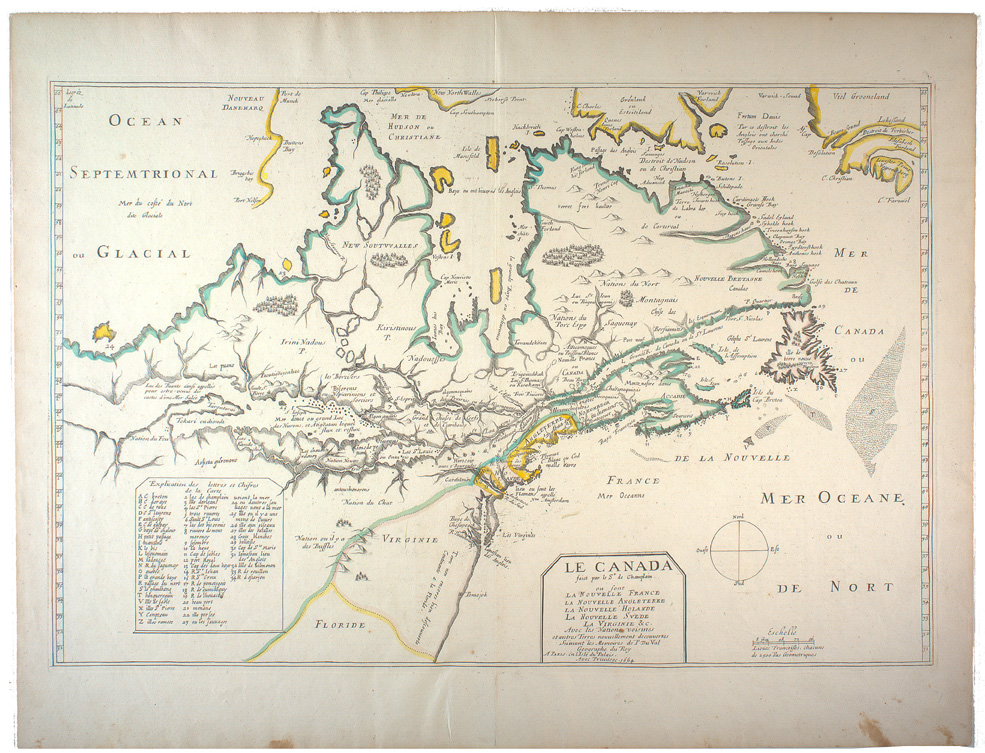
The Strength Of New France


From The Plains of Abraham by Brian Connell, a book about the French-Indian War:

"Strategically, French America occupied a position of almost impregnable strength."
"New France was more than Canada. It stretched more than three thousand miles from the mouth of the St. Lawrence to New Orleans at the mouth of the Mississippi."

Source Of An Early Map Ca. 1664 (McGill University)- Virginia And Florida Were Included

My In Deeds blog included another early map in a post entitled McGill University's Map Collection Online, remembering that Michigan was once part of Canada.

Saturday, April 20, 2013

First Impressions


From my blog post at the War of 1812 Chronicles:


In March I was contacted by the sponsoring editor of The Library of America's "THE WAR OF 1812: Writings from America's Second War of Independence" who indicated that a complimentary copy would be sent to me in exchange for a book review.

My first impression:

[To see the rest, follow the War of 1812 Chronicles link]


Friday, April 12, 2013

Trouble For The Regulators

This blog posts combines quotes from President Jimmy Carter's novel, The Hornet's Nest, as well as historical data and other blogs (including my In Deeds).  My real-life ancestors, the Trousdales, were there during this era of North Carolina history.

There were characters in The Hornet's Nest who migrated from Philadelphia to Orange County, North Carolina, in 1765. My Trousdales were in Orange County in the 1700's and probably lived in Pennsylvania before moving there, somewhat paralleling the lives of the fictional Pratt brothers.

The western North Carolina farmers in the area of Orange County chafed at the colony's governance, particularly the power wielded by Governor Tryon and Edmund Fanning (Fanning was described as someone who was supposed to be "just the register of deeds, but [made] all the final decisions at the courthouse..".

A deed involving John Trousdale and James Trousdale mentioned the Haw river and Great Alamance:

Whereas John Trousdale, some time ago having purchased a tract of land from Mary E. McCulloch, being the tract in the fork of Haw river and Great Alamance, and containing six hundred and twenty acres... .

Source
"....the Stockards, the Trowsdales, the Freelands, the Albrights....".

A small group of politically active men with grievances formed the Sandy Creek Association.  One of the characters, Henry Pratt, who was a member of the association, "joined up with some other men, both in Orange and other western counties, to form a group known as the Regulators."

William Trousdale and John Trousdale both signed a document vouching for the character of a Regulator who was in trouble, according to this document (and this site).

When the government's militia confronted the Regulators, there was trouble -- big trouble, culminating in the Battle of Alamance.

Source

My ancestor, Alexander Trousdale, moved from Orange County, North Carolina to Montgomery County, Tennessee.

Friday, February 1, 2013

Clotel Was Authored By A Former Slave

Clotel; or, The president's daughter, A Narrative Of Slave Life, by William Wells Brown, published in London in 1853, was written to "...aid in bringing British influence to bear upon American slavery...".

The first several pages contain an account of the author's life:

William Wells Brown, the subject of this narrative, was born a slave in Lexington, Kentucky, not far from the residence of the late Hon Henry Clay.  His mother was a slave of Dr. John Young and his father was a slaveholder.  After the doctor moved to Missouri his slaves were under the control of an overseer named Cook.  When William was 12, the doctor moved to St. Louis; William was sent to work for an innkeeper named Freeland.  After running away, he was captured and returned to the "monster" Freeland.  William was later lent to Elijah P. Lovejoy, an editor of an abolition newspaper who was later murdered at Alton, Illinois, by a gang of slaveholders from Missouri.

William W. Brown then worked on a steamer until he was hired by slave trader James Walker.  "Here subject of our memoir was made superintendent the gangs of slaves that were taken to the Orleans market. In this capacity William had opportunities far greater than most slaves of knowledge of the different phases of the institution."

Eventually William was sold to Captain Enoch Price, owner of the steamboat St. Louis.  He managed to escape again and was helped by a Quaker named Wells Brown; that's how William became William Wells Brown.  William Wells Brown continued on his way to Canada.


William Wells Brown then went to Monroe, Michigan, where he opened a barber shop.  After a few more twists and turns in his life, he became a lecturer.  His wife died in Buffalo, New York, in 1851.

Mr. Brown remarried in 1860; there's a reference to his wife, Anna Elizabeth (Gray) Brown "who later published Brown's work under the imprint A.G. Brown."

A summary of Clotel can be found here.


Sunday, August 26, 2012

A Theatre In Historic Savannah

The bookHistoric and picturesque Savannah, included the announcement of a new theatre (the Historic Savannah Theatre) that opened on December 4, 1818, featuring Cherry's comedy of the "Soldier's Daughter."


Savannah's riverfront, a few blocks north of the Savannah Theatre


Hat Tip to the 19th Century Historical Tidbits blog.